_edited.jpg)


The order form is at the
bottom of this page.
Native Tree Giveaway
Trees for our Next Generation
Native Trees Restore Biodiversity and Keep us Cool.
40% tree coverage is needed to get a cooling effect in a city. In Toronto, we have neighbourhoods that lack tree coverage, and we want to help change this. We can all plant another native tree in our yard and therefore will play an active part in making the world a better place for us, future generations, and wildlife alike. And we thank you for planting the biggest possible tree for your available space to make the most significant impact.
This tree giveaway, we also want to ask you to take some time and find a way to share the tree giveaway with people in neighbourhoods with low tree canopy. This will have a greater benefit to the living standard of our City as a whole. Through providing excellent shade and through transpiration, trees reduce the City's heat island effect by 5ºC in summer. As a windbreak, they also save heating costs in winter. Their green appearance, beauty, and scent reduce stress, increase school performance, and contribute to our overall health and well-being. One Oak, Maple, or other medium-sized tree sequesters over 3200 kg of CO2, mitigates about 513,000 litres of stormwater, and removes around 77 kg of air pollutants during its life. Trees provide privacy and increase property value by up to 20% for your property and neighbourhood.
Native trees also greatly benefit wildlife by providing food and shelter, thereby helping counter biodiversity loss.
The City of Toronto has the visionary goal of a 40% tree canopy cover by 2050 to become one of the most livable cities in the world. The City has made this event possible by generously providing all the trees through a
Community Planting & Stewardship Grant for this Neighbourhood Tree Giveaway.
Therefore, the trees and shrubs are for Toronto residents only and can only be planted within City boundaries on private property.
We will have the spring tree pick-up in cooperation with Anson Park Public School this Spring.
NEW LOCATION!
Anson Park Pubic School
30 Macduff Crescent,
Scarborough, M1M 1X5
on October 7, 2026
from 5 pm to 7 pm
Anson Park Public School will hold their Scholastic Book Fair at the same time. Everyone is invited.

You can order free native trees/shrubs to plant on your private property within Toronto's borders. Check out the offered species below and match them to your garden conditions and space.
Good to know:
-
All trees are native to Toronto and suited for our urban environment.
-
The trees come in 1-gallon pots and are small enough to be carried home easily.
-
For the long-term health of a tree, it is much better to plant younger trees than more developed trees since their root system is not damaged from growing too long in too small pots and becoming root-bound or grown in nursery beds and getting their roots regularly cut and severed. The very best way to achieve the long-term success of a tree would be to plant a few-month-old saplings if you can protect them.
-
When you plant any tree, make sure to open up the roots so they do not keep growing in a circle!
-
In the wild, trees grow in communities. Planting in groups of at least two to three trees together on a 6-foot center is ideal. The tree roots will interlock, giving them excellent stability, and they will support each other in producing a healthy, resilient environment.
-
It is best to remove the lawn generously around the tree/s and replace it with some understory trees, shrubs, ground cover or sedges. This enables a small ecosystem to get to work; insects will complete their life cycle in the soil because they have a soft landing when they fall off the tree and, therefore, can fulfill their role in the food web as a protein-rich food source for other wildlife, like our birds. Additionally, the soil around the root system will not constantly get compacted by mowing the lawn, so the soil organisms can form beneficial mutual relations with the trees and enhance their health. Check out the concept of a soft landing on Heather Holm's fantastic website.
-
The soil around the tree must always be covered to stay alive and for the tree to thrive. Mulch, like wood chips or leaves, is commonly used. Even better are plants as ground cover, like wild strawberry, wild ginger, native Solomon's seal or native sedges. Rainfall on bare soil compacts the soil and causes depletion of nutrients and all beneficial soil life.
-
The mulch cannot touch the tree trunk, which causes rot, but it should be put around in a doughnut shape.
-
Thanks to Birchcliff Treecare, we have free mulch available at the old location, 3995 St. Clair Ave East, behind the white garden fence. Please feel free to go there and pick up mulch.
-
A pollinator garden with short plants so that the tree gets enough sunlight can also be planted around the tree and maintained as long as the tree is still small and doesn't shade the pollinator plants.
-
Fall is the best time to plant a tree since it doesn't need to produce seeds, and the roots still grow as long as the soil isn't frozen.
-
Spring is the second-best time to plant a tree because trees don't need to deal with the stresses of the summer heat, but since they need to produce leaves and flowers, they need a lot more water to perform these tasks.
-
It is imperative to protect young trees from damage. One small nick with the lawnmower will develop into a larger wound as the tree grows. Trees can never heal their injuries, and the injuries will always stay a weaker entrance point for disease.
-
Plant your trees and shrubs as soon as possible, ideally within a week.
-
Call OntarioOneCall at least five days before you dig. It's the law.
-
Species of the trees/shrubs are subject to availability and may change or be substituted.
-
Some of the offered species are edible for humans. Please conduct thorough research on how to prepare the plant for safe human consumption. Also, remember that wild food is very potent. Please always test with small quantities if you might be allergic to a particular compound. And only eat small quantities.
Profiles of the Powerhouse Trees
for the Fall Tree Giveaway 2026
Appearance. Ecological Value. Growing Conditions.

Northern Red Oak
Quercus rubra
The Northern Red Oak is a large, hardy, long-lived shade tree and very tolerant of urban conditions. The attractive leaves often stay on the lower branches during winter and can add some privacy. Researchers believe this was a helpful defence mechanism to protect the young twigs from browsing giant sloths that went extinct about 13,000 years ago. Today, oaks sustain a complex and fascinating web of wildlife and are the ecologically most productive tree. The leaves provide food for over 500 species of caterpillars. Caterpillars are crucial since they are the most important food source for birds raising their babies. E.g. one pair of chickadees needs 9,000 caterpillars within six weeks of raising their young. And oaks will produce them. To better understand how vital oaks are for our ecology, especially for birds, watch Doug Tallamy's presentation and check out his newest book, "The Nature of Oaks." Oaks are the host plant for the beautiful Hairstreak butterflies.
In the fall, the leaves turn a beautiful orange and red. Once fallen, oak leaves are better mulch than wood chips. They likewise don't decompose during one season. Still, they are loose enough to offer habitat to firefly larvae, bumblebee queens, and many other beneficial insects during winter, and they are said to repel slugs and grubs.
Acorns are an abundant food source for small mammals, birds like ducks, turkeys, woodpeckers, blue jays, and even beavers and black bears. Blue Jays hide over 100 viable acorns up to one mile away from the mother tree every day for a month, making them the number one planter of oaks. Older trees often have cavities that provide shelter and nesting sites for birds and mammals.
Natural companion plants are Sugar Maple, other Oak and Hickory species, Pagoda Dogwood, Chokeberry, Asters and woodland plants.
Large
Height: 60+ ft
Width: 60+ ft
Requires full sun to partial shade
Adapts to moist and dry soil conditions
Prefers acidic soil, but can grow in any soil

Eastern White Pine
Pinus strobus

The Eastern White Pine is Ontario's iconic provincial tree. The tall trees are captured windswept in the paintings of the Group of Seven. It is a big shade tree that helps reduce energy consumption and cost as a windbreaker and shade tree.
Not noticeable at first glance, the tree has a high wildlife value since every part is edible- even for humans. Nuthatches, chickadees, grosbeaks, woodpeckers, and many other birds love the seeds. The buds, needles, bark, twigs and young cones help many animals get the nutrition they need during different seasons and to survive the winter. We can use ground pine needles in many recipes, raw or baked. The needles contain high amounts of Vitamin C and A. Indigenous peoples have used Eastern white pine to soothe the respiratory system as an effective medicinal plant. Its needles and resin have "anti-inflammatory, antiseptic, stimulating and relaxing, aromatic, pungent and stabilizing qualities, with particular benefits for the upper respiratory system, stomach, liver and kidneys. " Quote nelma.org.
Dense horizontal branching attracts small birds like warblers and purple finches, bigger birds like mourning doves, crows and blue jays, as well as great horned owls and red-tailed hawks to build their nests. Many birds collect young pine needles to cushion their nests.
Large
Height: 50 ft
Width: 20 ft
Requires full sun to partial shade
Very adaptable to moist and medium soil moisture and all types of soil conditions
Sensitive to atmospheric pollution

Red Maple
Acer rubrum
Red maple is well named because the tree's flowers, samaras (keys containing the seeds), and autumn leaves are distinctly red. This makes for a striking contrast against the dark green of evergreens, the white bark and yellow foliage of birches, or the blue sky. Red maple can grow as a specimen tree or a multi-stemmed plant.
Red maple is a very adaptable tree and, therefore, easy to grow. It tolerates great moisture and thrives on a wide range of soil types.
The red maple is a large, fast-growing shade tree that is of great value to our native wildlife. Maple sap is dripping out of small injuries and is enjoyed by birds and small mammals in late winter. Maples are among the first trees to bloom in spring. Even though they are wind-pollinated, they offer nectar and pollen and are vital for pollinators coming out of dormancy. The leaves feed almost 300 caterpillar species that supply ample food for breeding birds. Finches, wild turkeys, ducks, and various mammals eat the seeds. The twigs, buds, and bark become a lifesaving winter food source for small mammals and deer.
Great understory trees are American elderberry, hazelnut, pagoda dogwood, and fragrant sumac.
Native Solomon's seal, Canada wild ginger, wild geranium, foamflower, wood asters, New England asters, grey goldenrod, blue stem goldenrod and zigzag goldenrod are perfect ground covers and pollinator plants underneath red maples.
Height: 40+ ft
Width: 30+ ft
Requires full sun to part shade
Prefers moist soil of any type
Can tolerate swampy conditions

Paper Birch
Betula papyrifera
Paper birch is a medium-sized tree that can grow one or multiple stems. Its white bark is very attractive.
The role of the paper birch in ecology is to revegetate disturbed sites quickly as an early successional tree.
As a pioneer species, it can tolerate disturbed soil, typical of our city's soil, and will grow rapidly.
The seeds are food for many birds and mammals. The bark, twigs and buds are loved by many animals, from moose to deer to beaver.
Large
Height: 50 ft
Width: 20 ft
Requires full sun
prefers moist, well-drained soil
of all types
Small Understory Tees / Shrubs
These small understory trees or shrubs are wonderful in a small garden or create a beautiful layered look in front of big trees. They can be kept with multiple stems as a shrub or pruned to a small tree with one leading stem. These shrubs /small trees are essential for birds, providing cover and nutritious berries and seeds.
They also offer abundant nectar and pollen for bees and often bloom early.

Chokecherry
Prunus viginiana

Chokecherry is a hardy, very easy-to-grow small understory tree or large shrub. In the wild, it grows under large trees like oaks and maples. Chokecherry is beautiful year-round.
Showy white flower clusters offer nectar and pollen to early emerging mining bees in the spring. Being part of the prunus family, the leaves of chokeberry are food for caterpillars of hundreds of species of butterflies and moths. Some of the most iconic ones are the Easter tiger swallowtail butterfly, the Coral hairstreak butterfly, the Cecropia moth, the Promethean moth, and the Elegant sphinx. The berries first turn green, then red, and finally dark blue in the summer. They are a favourite of songbirds.
In the fall, the leaves turn a vibrant red-purple colour.
Small
Height: 8-25 ft
Width: 8-15 ft
Very adaptable to full sun and almost full shade
Dry to medium-moist, alkaline sand, loam, clay
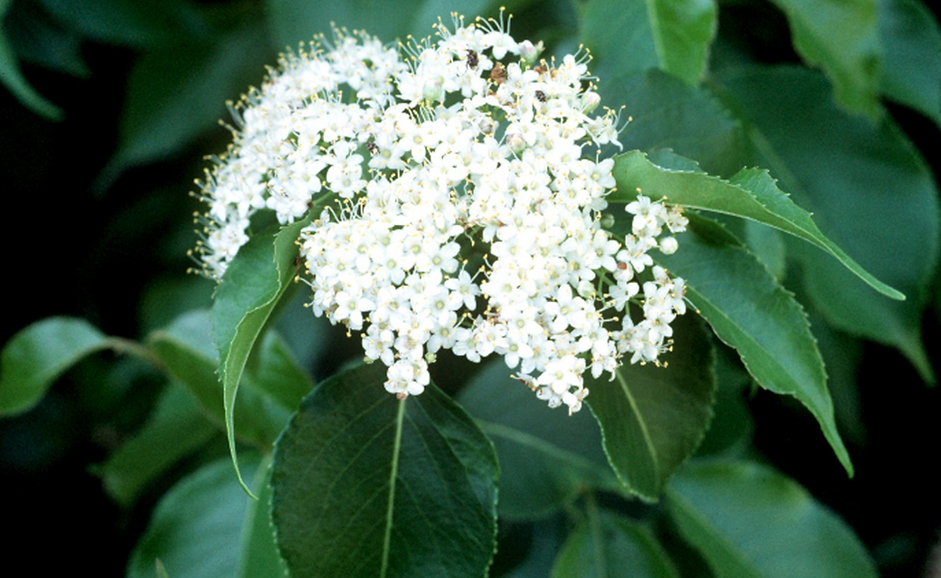
Nannyberry
Viburnum lentago
Nannyberry is very easy to grow. It can make a great privacy hedge by letting suckers grow, or it can be pruned back to a small tree. Nannyberry is beautiful year-round.
Showy white flower clusters offer nectar and pollen to mining and sweat bees in the spring. The leaves are the larval food for the caterpillar of the Spring azur butterfly. The berries turn almost black in September and provide a consistent food source for birds into winter. The berries are also edible for humans right off the bush or can be used in jams and jellies.
In the fall, the leaves glow in a rich burgundy colour. Next season's flower buds form early, so you must prune right after blooming.
Small
Height: 15-20 ft
Width: 6-12 ft
Very adaptable to full sun and part shade
Dry to moist well-drained soils


Pagoda Dogwood
Cornus alternifolia
Pagoda dogwood is an attractive small understory tree or shrub, depending on whether it is pruned to a single-stem tree or left to form a multi-stemmed shrub. It has clusters of white flowers in spring and provides an excellent early-season source of pollen and nectar. It allows specialist mining bees that depend on its specific pollen to reproduce, but it also allows a wide array of different species of bees access to its nectar through its open flower form. Pagoda dogwood feeds the caterpillars of the elegant Spring Azure butterfly as a host plant. The dark blue berries look stunning on their red stems, but they don't last long because they are a favourite of many fruit-eating birds, including cedar waxwings, juncos and cardinals. Fruit is high in fat and energy, therefore attracting many species of birds. Host plant for the larva of the spicebush swallowtail butterfly.
The dark green leaves turn an attractive purple in the fall. The wide horizontal branches give this tree a distinct look. When loaded with snow, they create a winter wonderland.
Pagoda dogwood provides very high ecological value for wildlife and is beautiful year-round.
Height:15-25 ft
Width: 15-30 ft
Very adaptable to full sun and partial sun
Prefers moist, well-drained soils, can tolerate dry sites and heavy clay.

Serviceberry
Amelanchier canadensis

Serviceberry is an adaptable large shrub or small tree, depending on whether it is pruned to a single-stem tree or left to form a multi-stemmed shrub.
Serviceberry trees provide very high ecological value for wildlife and are beautiful year-round.
Serviceberry trees put on a show of white flowers in spring and provide an excellent early-season source of pollen and nectar. The open form of the flowers allows many different kinds of bees access to their nectar. The leaves support 100 different caterpillar species, including the caterpillars of the White admiral and the Eastern tiger swallowtail butterfly. The small, round, sweet berries ripen in the summer. They are edible, super delicious and healthy, even in large quantities. They are a sought-after berry for over 40 species of birds, including orioles, bluebirds, cedar waxwings, scarlet tanagers, northern flickers, and robins, so we might not get too many. The tree produces more berries when it gets more sun.
In the fall, the leaves turn into an array of stunning colours, from orange to purple and red.
Height:15-25 ft
Width: 15-25 ft
Very adaptable to full sun and shade
Moist to dry, well-drained soil of various types

Fragrant Sumach
Rhus aromatica

Fragrant sumac is a sprawling, small to medium-sized shrub that can be used as a groundcover. When crushed, the foliage exudes a beautiful citrus scent. It grows best in fertile soil and full sun. However, it will tolerate dry or compacted soils, partial shade, and other urban conditions.
It is the host plant for the Red-banded hairstreak butterfly.
Only female plants produce dark-red berries that persist into the winter and are eaten by resident birds.
Deer do not like fragrant sumac.
The leaves have stunning fall colours with orange, red, purple, and yellow hues.
Small
Height: 3-5 ft
Width: 6-12 ft
Very adaptable to full sun and partial sun
Moist, well-drained to dry soils
Shrubs

Spicebush
Lindera benzoin
Spicebush is a fast-growing understory plant that likes to grow especially under beeches, oaks, and maples in part shade. Yellow flowers bloom early in spring before the shrub leaves out. The leaves and twigs are aromatic and can be used as a spice to flavour savoury and sweet dishes. They have a citrus - peppery flavour and can also be used to make tea. Female spicebushes get showy red berries, which are a culinary treasure. Since the trees are dioecious, meaning there are separate male and female plants, there must be a male spicebush in proximity for the female plant to produce the bright red, berry-like fruits in late summer. This means it is best to have several spicebushes growing in neighbouring gardens to increase your odds of getting fruit.
Spicebush is the larval host plant for the Eastern tiger swallowtail, the promethea silkmoth and the funky caterpillar of the spicebush swallowtail butterfly.
The leaves turn yellow in the fall.
Height: 6-12 ft
Width: 6-12 ft
Very adaptable to full sun and partial shade
Prefers moist, well-drained soils, tolerant of wet sites.
Spicebush swallowtail caterpillar
How to Support Your Tree for best Growth and Health
All the offered trees and shrubs are quite easy to grow and are adapted to our climate and urban stresses. It is still important to find the right tree for your needs and the right location in your yard for your tree.


Assessing Your Yard
What should the purpose of your tree be?
Space, sun and moisture greatly determine which species can grow in a given spot.
Planting Your Tree
Trees and shrubs are best planted in the fall. It is most important to loosen and open up the roots in the root ball. If the roots have grown in a circular motion, they will stay that way but become bigger and eventually strangle the tree. By taking care while planting, you can significantly increase your tree's resilience, health and the age your tree can reach.
Mulching with wood chips or leaves will keep the soil moist longer, suppress weeds and kick-start the mycorrhizal fungal networks and other soil microorganisms that have beneficial relations with your tree.
Caring for Your Tree
Deep Watering!
It is essential to help develop a healthy root system in the first years. Keep the hose close to the tree on a slow trickle for 15 minutes to allow the water to infiltrate deep into the soil. Then move the hose and repeat 3 times so that all four corners are well watered. This will encourage the tree to develop a deep rather than a shallow root system, which makes your tree more resilient to drought and storms.