_edited.jpg)

Mosquito, Tick & spider
spraying
Biodiversity protects against Patogenes
We are very concerned about the new trend of people wanting to "protect" themselves from mosquitoes, ticks, and spiders by having their yards sprayed with Pyrethroids.
Pyrethroids are toxic to all insects, including
-
all pollinators (in charge of producing food and seeds so plants can reproduce),
-
all butterflies and moths (the nonnegotiable base for our terrestrial food web, including baby bird food),
-
all predatory insects, like spiders and wasps (in charge of keeping your yard healthy and in balance),
-
developing moth and insect larvae above ground and in the soil.
Pyrethroids are also toxic to:
-
many soil organisms, like springtails, and soil microorganisms,
-
many beneficial mycorrhizal fungus species that enable nutrient cycling, with the result that about 30% of biological soil fertility is lost. (Mycorrhizal fungi feed plants directly with nutrients and water).
-
US EPA, Canadian and EU databases explicitly classify pyrethroids as "very highly toxic" to aquatic organisms.
Pyrethroids are also toxic to humans and pets and, therefore, banned in Ontario, with the exception of a health emergency. This is the loophole that allows lawn and pest control companies to get a license to spray.
David Suzuki points out in this article that we haven't learned anything from the DDT crisis.

Why is spraying harmful to your
pollinator garden?
Pyrethroids will kill all insects. The problem is that mosquitoes reproduce very quickly, about every 2 weeks, whereas most bees, moths, butterflies, spiders, and dragonflies only reproduce once per year. While mosquitoes return, their predators do not, creating a vicious cycle.
Unfortunately, the chemicals are not contained within an area but are carried by the wind to neighbouring gardens, where they remain so potent that they can also wipe out all insect life.
Pyrethroids bind to soil particles and stay active for months.
They can reach streams and waterbodies through erosion and runoff.
Why is Biodiversity protective?
We are all very concerned about Lyme disease, and rightfully so. There is no scientific evidence that a simplified garden reduces the incidence of contracting Lyme disease. The only safe measure is to perform tick checks on your body and to remove the ticks within 24 hours.
But one thing science points out, valid on both global and local scales, is that biodiverse landscapes are protective and healthier landscapes for humans.
Why is a biodiverse landscape protective?
Greater biodiversity creates a better balance among all members of the ecosystem. Richer, more complex food webs have predators that maintain balance and prevent the overabundance of super-spreader species. The main hosts of Borrelia bacteria that cause Lyme disease are white-footed mice and other small mammals and birds. In simplified landscapes, smaller animals with faster reproductive cycles become unnaturally abundant, and they are more often hosts for disease.
If we have greater animal diversity in our landscapes, tick nymphs will feed on many different animals, most of which cannot transmit the Borrelia bacterium, so the ticks will not become infected and will not be able to spread Lyme disease. This is called the dilution effect. Check out the article from Homegrown National Park on homegrown diversity, infectious disease, and the dilution effect.
Interestingly, science found that landscapes simplified by humans also reduce overall mosquito diversity but favour a few species that are very good at living with humans and transmitting disease, such as West Nile. Bats, birds, spiders, dragonflies, and frogs are effective predators for mosquitoes.
Research shows that diverse ecosystems are more balanced and healthier ecosystems, including for humans.
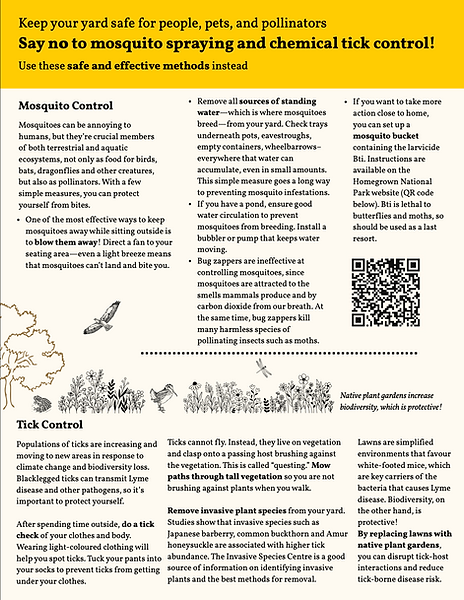

How to spread the word
It is not difficult to get this information published in local newspapers, and it is especially important to get it out in areas with lakes and streams. Please check out Catherine Clysdale's article and feel free to use whatever you like.
Please download the PDF of the above info sheet and share it freely with your friends and groups through email and social media.
Please write to your councillor and ask them to ban spraying. (A sample letter will be added soon.)
